How Much Money Do I Actually Need Saved to Buy a House If My Credit Is Average?
How Much Money Do I Actually Need Saved to Buy a House If My Credit Is Average?
The real number is less than you think — and there's a tool called seller assist that can cut it even further.
By Jonathan Jackson | Providence Mortgage Group
How Much Money Do I Actually Need Saved to Buy a House If My Credit Is Average?
How Much Money Do I Actually Need Saved to Buy a House If My Credit Is Average?
The 20% Myth Is Keeping People Renting
Let's Talk About Closing Costs (The Number Nobody Warns You About)
Seller Assist: The Tool That Changes Everything
Down Payment Assistance: Stacking the Tools
Let's Build Your Actual Number
What Actually Matters (The "Not Yet" Philosophy)
Five Questions People Actually Ask
The Real Answer
Let me cut straight to it.
If your credit score is in the 620–660 range — which is what most people consider "average" — you could qualify to buy a home with somewhere between $13,750 and $21,250 out of pocket on a $250,000 house. That includes your down payment and closing costs.
I know. Not what you were expecting.
But here's where it gets even better: if the seller agrees to cover some of your closing costs — which is called a seller assist, and it happens more than people realize — that out-of-pocket number can drop to $8,750 or less. On a $250,000 purchase.
And if you live in a rural area and qualify for a USDA loan? You could buy with as little as $0 down. With a seller assist, some USDA buyers walk into closing paying almost nothing out of pocket.
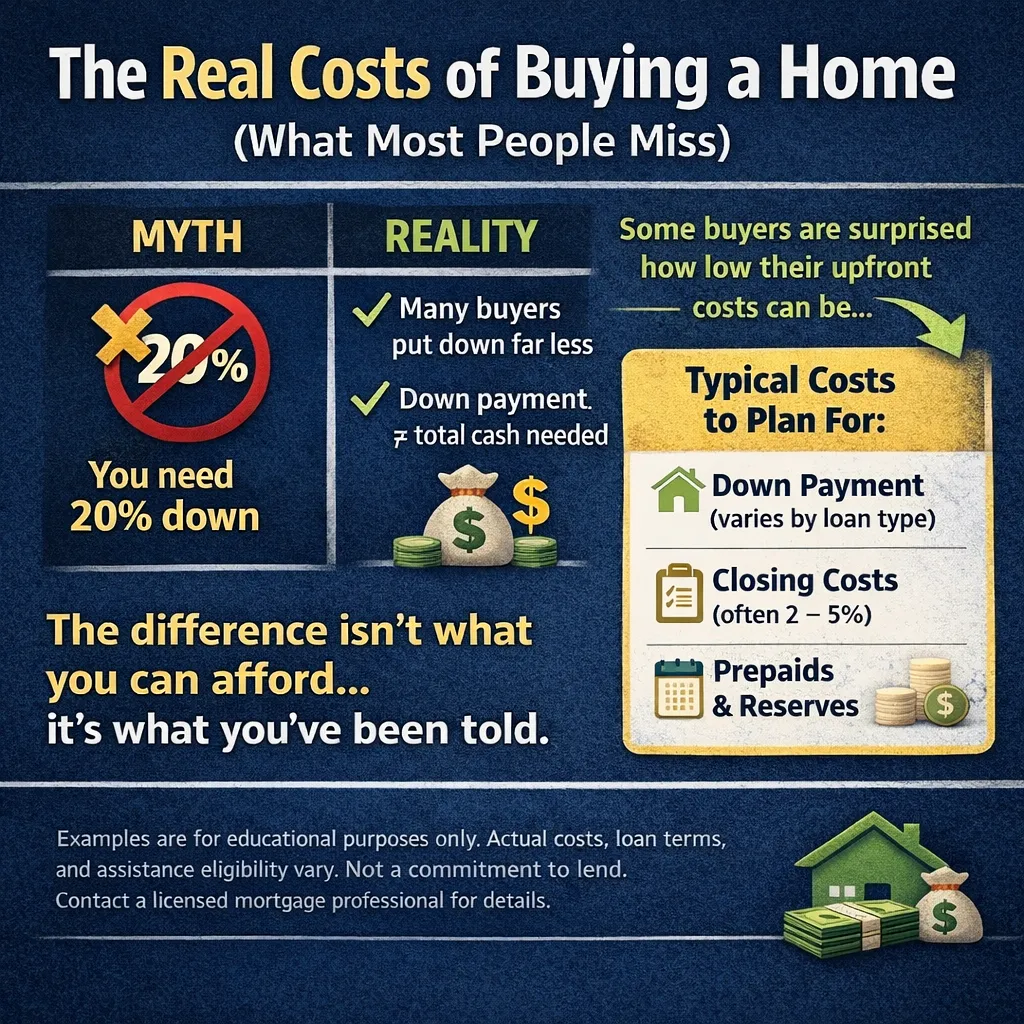
The problem isn't that this information doesn't exist. The problem is that 62% of Americans are walking around believing they need 20% down before they can even think about homeownership. That myth is costing families years of renting they didn't want to do — and it's based on a number that stopped being required back when disco was still popular.
I've watched smart, stable people — people with good jobs, solid credit, and reasonable debt — sit on the sidelines because they thought they needed to save $50,000, $60,000, or more before anyone would look at their mortgage application. Meanwhile, they're paying $1,400 a month in rent to someone else's mortgage.
So let me show you what's actually possible.
Key Takeaways
You do NOT need 20% down. The median first-time buyer in 2024 put down 9% — and many put down far less.
Average credit (620–659) qualifies you for FHA loans at 3.5% down, which is $8,750 on a $250,000 home.
Closing costs in Pennsylvania typically run around 5% of the purchase price — and this is the number most people forget to plan for.
Seller assist is a real and commonly used tool — sellers can often contribute 3–6% toward your closing costs, dramatically reducing your out-of-pocket total.
Down payment assistance programs in PA can cover part or all of your down payment, stacking with seller assist to get your cash-to-close number very low.
The 20% Myth Is Keeping People Renting
The 20% down payment rule is left over from the era after the 2008 housing crisis, when lenders tightened everything and people started talking about this number like it was law. Before that — way before — FHA loans were created in 1934 specifically to help people buy homes without massive down payments.
But somehow, that 20% number stuck. It became the thing people mentioned at dinner tables. It became the goalpost everyone aimed for. And for a lot of people, it became the reason they didn't even try.
Here's what I've seen: A young professional with a solid job and 625 credit decides to wait five more years until they save $60,000, because they believe that's what they need. Meanwhile, they're renting. They're building zero equity. They're paying someone else's mortgage instead of their own. And by the time they do save that $60,000, home prices have moved, interest rates have shifted, and the math looks completely different.
The worst part? They could have started years earlier.
I've had clients come in genuinely shocked when I told them what they actually qualified for. Not in a bad way. In the "why didn't anyone tell me this?" way. That's the conversation I want to have with you right now.
What the Data Actually Shows
According to the National Association of Realtors' 2025 Profile of Home Buyers and Sellers, the median down payment for first-time homebuyers in 2024 was 9%. Let that sink in. Nine percent. Not 20%.
For repeat buyers, the number was 23%. But first-time buyers? Nine percent. And a significant chunk of those buyers used down payment assistance programs, seller concessions, or both.
Thirty-two percent of first-time buyers said that saving for the down payment was the most difficult part of buying a home. Not the credit score. Not the income. The down payment — because people believe they need $50,000+ when they often need far less.
Here's the breakdown of what you can actually qualify for, by credit tier:
If Your Credit Is 580–619
You're in FHA territory. With a 580–619 credit score, you can qualify for an FHA loan at 10% down minimum. On a $250,000 home, that's $25,000 down. Add 5% closing costs ($12,500) and you're looking at $37,500 to close without any seller assist.
That's a lot. Here's what changes it: if you can negotiate a 3% seller assist ($7,500), your out-of-pocket drops to $30,000. Still significant, but a meaningful reduction.
And here's the path forward: most people in this credit range can add 20–40 points in 60–90 days with focused effort. Get to 620 and everything below unlocks.
If Your Credit Is 620–659
This is what most people call average credit — and it opens the most doors. FHA loans drop to 3.5% down, and down payment assistance programs start taking you seriously.
On a $250,000 home:
Down payment at 3.5%: $8,750
Closing costs at 5%: $12,500
Total without help: $21,250
That's still a real number. But now let's add the tool most buyers forget to use.
With a 3% seller assist ($7,500 on a $250K home):
Your down payment: $8,750
Closing costs after seller assist: $5,000
Total out of pocket: $13,750
That's the number. $13,750 on a $250,000 home with average credit. And if you layer in Pennsylvania down payment assistance on top of that, it gets lower.
If Your Credit Is 660+
Welcome to the sweet spot. Conventional loans open up at 5% down, down payment assistance programs are most flexible, and lenders have the most flexibility on your overall profile.
On a $250,000 home at 5% conventional down:
Down payment: $12,500
Closing costs at 5%: $12,500
Total without help: $25,000
With a 3% seller assist ($7,500):
Your down payment: $12,500
Closing costs after seller assist: $5,000
Total out of pocket: $17,500
The benefit of 660+ isn't just the lower down payment on FHA — it's that you have options. You might choose FHA for the lower down payment. You might choose conventional to avoid FHA mortgage insurance. And seller assist is available on both.
Let's Talk About Closing Costs (The Number Nobody Warns You About)
Here's what I tell every client: the down payment isn't the only money that changes hands at closing. There are closing costs, and if nobody explains them to you upfront, they feel like a gut punch when you get your Closing Disclosure three days before closing.
In Pennsylvania, closing costs typically run around 5% of your purchase price. On a $250,000 home, that's $12,500. On a $300,000 home, that's $15,000.
What are closing costs? They include:
Appraisal fee
Title search and insurance
Home inspection
Loan origination fees
Underwriting fees
Prepaid property taxes
Homeowners insurance (first year)
Mortgage insurance (if applicable)
Settlement or attorney fees
None of those are optional. They're all real costs that have to be covered at closing. And that's exactly why the down payment number alone tells an incomplete story.
Seller Assist: The Tool That Changes Everything
Here's the thing most buyers don't know to ask for: sellers can contribute toward your closing costs. This is called a seller assist or seller concession, and it's one of the most powerful tools in a buyer's toolkit.
When you make an offer on a home, you can ask the seller to contribute a percentage of the purchase price toward your closing costs. The seller doesn't write you a check — instead, the concession is factored into the deal structure, and those funds go toward paying your costs at the settlement table.
How much can a seller contribute? Here are the program limits:
FHA loans: Sellers can contribute up to 6% of the purchase price
Conventional loans (under 10% down): Up to 3%
Conventional loans (10–24% down): Up to 6%
USDA loans: Up to 6%
In a buyer-friendly or balanced market, asking for 3% seller assist is a completely reasonable and common request. In a hot seller's market, it's harder to get — but even in competitive markets, I've seen buyers successfully negotiate seller assists when they structure the offer well.
Here's why this matters: if closing costs are 5% and you negotiate a 3% seller assist, you've just cut your out-of-pocket closing costs from $12,500 to $5,000 on a $250,000 purchase. That's $7,500 that stays in your pocket.
Down Payment Assistance: Stacking the Tools
Here's the misconception I correct most often: people think down payment assistance is only for people who are completely broke. Wrong.
Down payment assistance programs in Pennsylvania typically require:
A minimum credit score (usually 620, sometimes 580)
A steady job or verifiable income
Completion of a homebuyer education course
Income within program limits (usually 80% of area median income)
They're designed for people who are doing the right things but need a bridge to homeownership.
Pennsylvania has excellent options:
The K-FIT Program (Keystone Forgivable In Ten) offers up to 5% of the purchase price — with no maximum dollar cap — forgiven at 10% per year over 10 years. Zero repayment if you stay.
The HOMEstead Program offers up to $10,000 in down payment and closing cost assistance as a forgivable loan, forgiven at 20% per year over five years.
The Keystone Advantage Assistance Loan provides up to 4% of the home price (max $6,000) as a zero-interest second mortgage spread over 10 years.
The key word in all of these is "stack." You can use a DPA program for your down payment AND negotiate a seller assist for your closing costs at the same time. These tools work together.
Let's Build Your Actual Number
Let's get concrete. Three scenarios, all on a $250,000 house, with 5% closing costs ($12,500). Every scenario shows the full number without help, and then what happens when you add a seller assist.
Scenario 1: FHA Loan, 620–659 Credit, No Seller Assist
Down payment (3.5%): $8,750
Closing costs (5%): $12,500
Total out of pocket: $21,250
Scenario 1 + 3% Seller Assist ($7,500 toward closing costs):
Down payment (3.5%): $8,750
Remaining closing costs: $5,000
Total out of pocket: $13,750
Scenario 2: FHA Loan + PA DPA (K-FIT), 620–659 Credit
K-FIT covers 5% of purchase price as down payment: $12,500 (covers your entire down payment)
Your cash down: $0
Closing costs (5%): $12,500
Total without seller assist: $12,500
Scenario 2 + 3% Seller Assist ($7,500 toward closing costs):
Down payment from DPA: $12,500
Your closing costs after seller assist: $5,000
Total out of pocket: $5,000
That's $5,000 on a $250,000 home. Five thousand dollars to own a home.
Scenario 3: USDA Loan (Rural Area, Income Qualifies)
Down payment: $0
Closing costs (5%): $12,500
Total without seller assist: $12,500
Scenario 3 + 3% Seller Assist ($7,500 toward closing costs):
Down payment: $0
Remaining closing costs: $5,000
Total out of pocket: $5,000
USDA loans are geographic — the home needs to be in a USDA-eligible area (most of rural Central PA qualifies) and there are income limits. But if you qualify, this is one of the most powerful loan programs available.
Scenario 4: FHA Loan, 580–619 Credit (The Comeback Path)
Down payment (10%): $25,000
Closing costs (5%): $12,500
Total without seller assist: $37,500
Scenario 4 + 3% Seller Assist ($7,500 toward closing costs):
Down payment: $25,000
Remaining closing costs: $5,000
Total out of pocket: $30,000
This one's harder. Which is why I tell clients in this credit range: we work on getting to 620+ first. Twenty points of credit improvement can cut your required down payment by more than half.
What Actually Matters (The "Not Yet" Philosophy)
I coach youth football. When a kid is frustrated because they can't do something yet — throw a spiral, run a route — the worst thing I can say is "you can't do that." The best thing I can say is "you can't do that yet. Here's what changes that."
Same philosophy applies here.
Most of my conversations start with someone thinking the answer is no. You can't buy with average credit. You can't buy without $40,000 saved. You can't qualify because of that missed payment three years ago.
But the answer is almost never "no." The answer is "not yet — and here's what changes that."
Not yet — but if we get your credit up 20 points in the next 90 days, your down payment drops from 10% to 3.5%.
Not yet — but if you're in a rural area, a USDA loan gets you to zero down and the seller assist handles closing costs.
Not yet — but the K-FIT program covers your down payment, and a 3% seller ask covers most of your closing costs, and you're closing for $5,000.
What matters isn't whether you have it all figured out today. What matters is that we map your actual situation, figure out what's holding you back, and build a clear path to the first move.
Five Questions People Actually Ask
Q: Can I negotiate seller assist in a competitive market?
A: Yes — but it's harder. In a balanced or buyer-leaning market, a 3% seller assist ask is normal and expected. In a strong seller's market, you might ask for less, or offer slightly over asking in exchange for the concession. The key is structuring the offer strategically. This is a conversation worth having before you write your first offer, not after.
Q: If closing costs are 5%, does the seller assist cover all of it?
A: A 3% seller assist covers $7,500 of a $12,500 closing cost total on a $250K home, leaving you with $5,000 to cover. If you negotiate 5% or 6% seller assist (which FHA and USDA allow), you can cover the full closing costs — but be careful: asking for too much can make your offer less competitive or trigger appraisal issues. I'll help you find the right number for your market.
Q: What if my credit is below 580?
A: You're not locked out permanently. You're in "not yet" territory. Below 580, FHA loan access is limited and some lenders won't go there. Here's what we do: work on your credit for 90–120 days. Pay down balances, dispute any errors, bring any accounts current. Thirty points of improvement can happen faster than most people expect — and at 580, the landscape opens significantly.
Q: Can the DPA program AND seller assist work at the same time?
A: Yes, and this is one of my favorite scenarios. DPA covers your down payment. Seller assist covers closing costs. You contribute very little out of pocket. I've walked clients through this combination and they've closed for amounts that surprised even them. The key is structuring everything correctly from the start, which is exactly the kind of thing a good loan officer should be doing proactively.
Q: How do I know if I qualify for USDA financing?
A: Two things need to be true: the property needs to be in a USDA-eligible area (large portions of Central PA qualify, including many suburbs people don't realize are eligible), and your household income needs to be within the program limits for your county and household size. USDA income limits in PA typically land between $110,000 and $145,000 for a household of four. The only way to know for certain is to check — I run this analysis for people all the time, and you'd be surprised how many properties qualify.
Here's What You Need to Do Next
Step one: get clarity on where you actually stand.
You don't need to walk in with perfect finances. You need to know:
Your approximate credit score (order a free report at annualcreditreport.com)
What you have saved right now
What you could realistically save in the next 90 days
What area you're looking to buy in (rural vs. suburban affects your program options significantly)
Step two: have a real conversation about your goals, not just the numbers.
Here's what separates how I work from how most lenders work: I don't lead with products. I lead with goals. Are you trying to buy in the next six months? Do you want to keep your payment low? Is preserving cash more important than minimizing the monthly? Is there a specific neighborhood or school district driving your timeline?
Once I understand what you're actually working toward, we work backward. Maybe that's an FHA loan with a seller assist covering closing costs. Maybe it's a USDA zero-down with minimal out-of-pocket. Maybe it's K-FIT stacked with a 3% seller ask that gets you in the door for $5,000.
The point is there's almost always a path. But you have to start the conversation first.
The Bottom Line
You do not need 20% down to buy a house.
You do not need to be wealthy, or nearly wealthy.
What you need is decent credit, steady income, and honest clarity about your actual situation. If you have those three things, I can show you a real path to homeownership. Maybe that path starts in 60 days. Maybe it takes 90 days of focused credit work first. But there is a path.
And I want you to know something about closing costs: yes, they're real, and yes, at 5% they're a significant number. But they're also something you can negotiate. Seller assist exists specifically because buyers and sellers can work together to make transactions happen. It's a completely normal ask — and one I walk my clients through every single time.
Don't sit on the sidelines waiting for a $50,000 number you don't need. Get your credit report. Figure out what you have saved. Then reach out.
Because here's the thing about waiting: every year you rent, you're paying someone else's mortgage. At some point, it should start being yours.
Author Bio
Jonathan Jackson is a loan officer and part-owner of Providence Mortgage Group, serving Central Pennsylvania. He built and scaled businesses for 15+ years — including managing IT through a $750M+ acquisition — before bringing a builder's approach to the mortgage world. He specializes in finding paths to homeownership for people others overlook. When he's not helping buyers figure out their real numbers, he's coaching youth football, where the philosophy is the same: nobody leaves without knowing what they're working toward.
